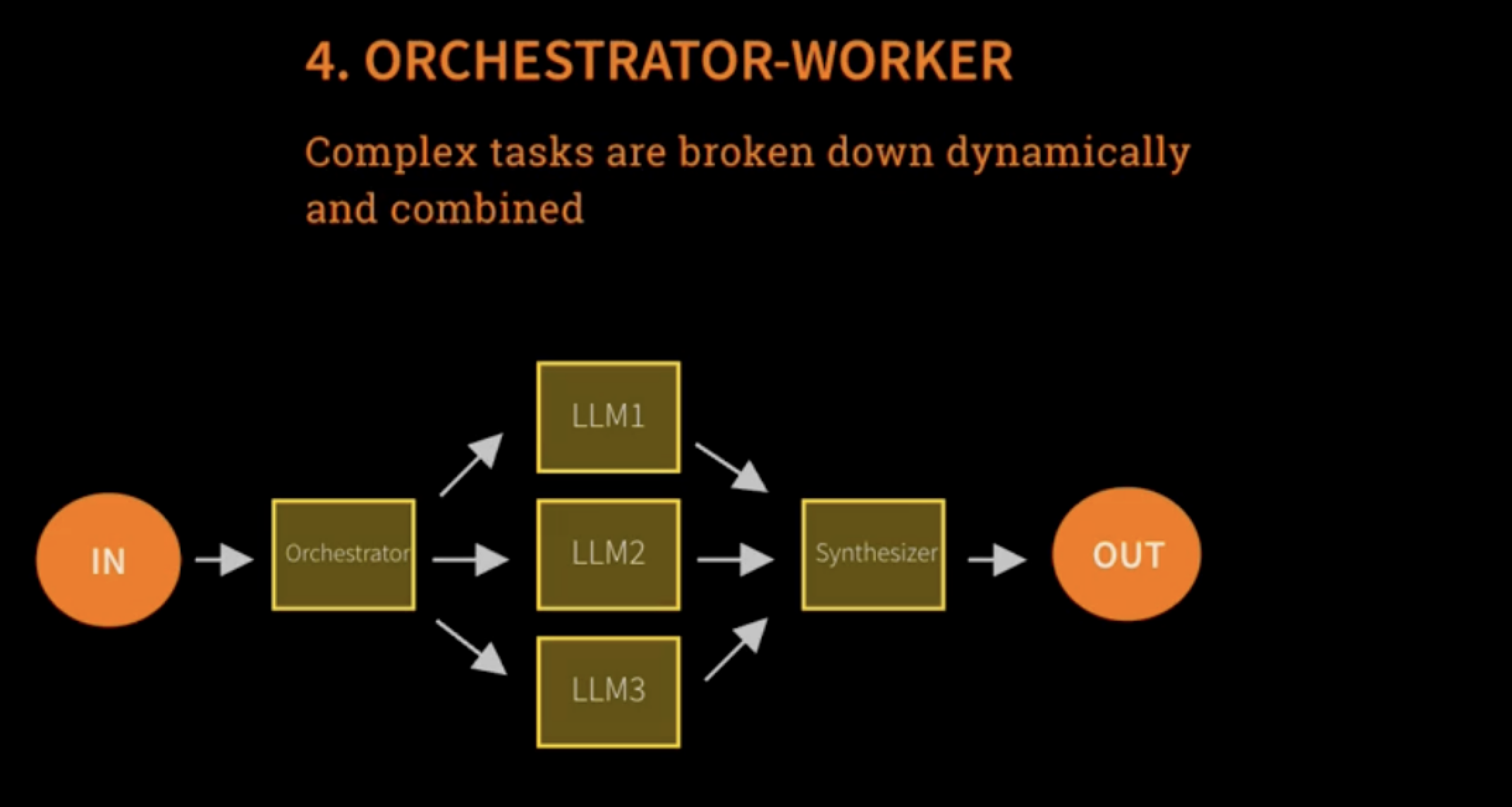
Orchestrator-Worker
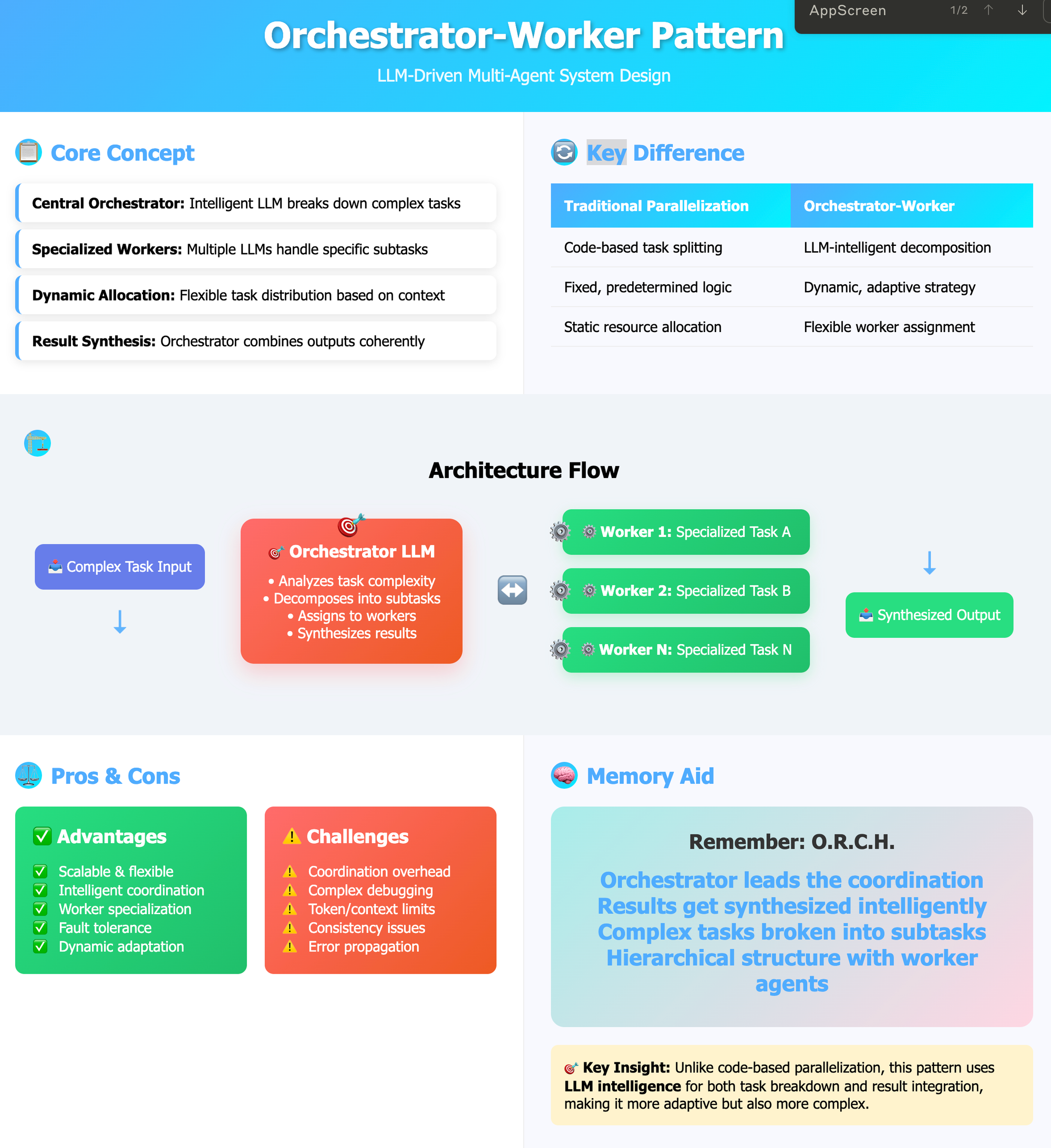
The orchestrator-worker pattern represents a sophisticated approach to multi-agent system design where a central Large Language Model (LLM) acts as an intelligent orchestrator, dynamically decomposing complex tasks into smaller, manageable subtasks that are distributed among specialized worker LLMs. Unlike traditional code-based parallelization, this pattern leverages LLM intelligence for both task division and result synthesis, creating an adaptive system where the orchestrator exercises discretionary control over work allocation and integration. This pattern bridges the gap between rigid workflow systems and flexible agent architectures, offering structured task management with intelligent adaptability.
Key Terms & Definitions
Orchestrator-Worker Pattern: A design pattern where one central agent (orchestrator) manages task decomposition, delegation to multiple worker agents, and synthesis of results.
Task Decomposition: The process of breaking down a complex, challenging task into smaller, more manageable subtasks that can be handled by specialized components.
Dynamic Orchestration: The ability of the orchestrator to adaptively decide how to divide tasks and allocate resources based on current context and requirements.
LLM Orchestration: Using Large Language Models to manage the coordination and control flow in multi-agent systems, rather than relying on traditional code-based logic.
Result Synthesis: The process of combining and integrating outputs from multiple worker agents into a coherent final result.
Multi-Agent System: A system composed of multiple intelligent agents that interact and collaborate to solve problems or perform tasks.
Agent Discretion: The degree of autonomous decision-making capability given to an agent within system constraints.
Worker Specialization: The assignment of specific expertise or task types to individual worker agents for optimal performance.
Workflow vs. Agent Pattern: Workflows follow predetermined paths with limited flexibility, while agent patterns allow for more autonomous decision-making and adaptive behavior.
Important People & Events
Key Figures & Organizations
Anthropic: AI safety company that has categorized and studied various LLM orchestration patterns, including their classification of the orchestrator-worker pattern as a workflow design.
Timeline of Related Developments
1970s-1980s: Early distributed computing patterns emerge, including master-slave architectures that influence modern orchestrator-worker designs.
1990s: Multi-agent systems research begins to formalize coordination and collaboration patterns in artificial intelligence.
2000s: Service-oriented architecture (SOA) and microservices patterns develop, contributing to task decomposition methodologies.
2010s: MapReduce and distributed computing frameworks mature, providing templates for large-scale task coordination.
2020-Present: Large Language Models enable intelligent orchestration, leading to the development of LLM-specific orchestrator-worker patterns.
2023-2024: Companies like Anthropic begin systematizing and categorizing LLM design patterns for multi-agent systems.
Core Architecture Components
The Orchestrator
- Primary Role: Central coordinator and decision-maker
- Responsibilities:
- Analyzes incoming complex tasks
- Determines optimal decomposition strategy
- Selects and assigns appropriate worker agents
- Manages communication flow
- Synthesizes final results
- Intelligence Level: High-level reasoning and planning capabilities
The Workers
- Primary Role: Specialized task executors
- Responsibilities:
- Execute specific subtasks efficiently
- Provide expertise in designated domains
- Report results back to orchestrator
- Specialization: May be domain-specific or general-purpose
Communication Layer
- Task Distribution: Orchestrator to workers
- Result Collection: Workers to orchestrator
- Status Monitoring: Bidirectional health checks and progress updates
Advantages & Benefits
- Scalability: Can dynamically adjust the number of workers based on task complexity
- Flexibility: Orchestrator can adapt strategy based on context and constraints
- Specialization: Workers can be optimized for specific task types
- Fault Tolerance: Failed workers can be replaced or tasks redistributed
- Intelligent Coordination: LLM-based orchestration allows for nuanced decision-making
Challenges & Limitations
- Coordination Overhead: Communication and synchronization costs
- Complexity Management: Difficulty in debugging distributed failures
- Consistency Challenges: Ensuring coherent results across multiple agents
- Token/Context Limits: Managing information flow within LLM constraints
- Error Propagation: Failures in workers can affect overall system performance
Comparison with Related Patterns
vs. Traditional Parallelization
- Orchestrator-Worker: LLM-driven intelligent task division
- Parallelization: Code-based predetermined task splitting
vs. Pipeline Pattern
- Orchestrator-Worker: Dynamic, non-linear task flow
- Pipeline: Sequential, linear processing stages
vs. Pure Agent Systems
- Orchestrator-Worker: Structured hierarchy with clear coordination
- Agent Systems: More autonomous, peer-to-peer interactions
Socratic Questions for Self-Assessment
- Conceptual Integration: How does the orchestrator-worker pattern balance the benefits of centralized control with the advantages of distributed processing, and what are the trade-offs involved in this architectural decision?
- Pattern Evolution: In what ways does LLM-based orchestration fundamentally differ from traditional code-based coordination, and how might this difference impact system reliability, adaptability, and maintainability?
- Scalability Analysis: Consider a scenario where task complexity increases exponentially - how would the orchestrator-worker pattern adapt, and what potential bottlenecks or failure points might emerge as the system scales?
- Classification Debate: Anthropic categorizes this as a "workflow" rather than an "agent pattern." What evidence supports each classification, and what are the implications of this categorization for system design and implementation?
- Real-World Application: If you were to implement an orchestrator-worker system for a complex research task (like analyzing multiple scientific papers to generate a comprehensive literature review), what specific challenges would you anticipate, and how would you design the system to address them?
Additional Study Resources
Academic Papers & Research
- Multi-Agent Systems: Algorithmic, Game-Theoretic, and Logical Foundations
- Distributed Artificial Intelligence research papers
- Large Language Model coordination studies
Technical Documentation
- Anthropic's AI system design patterns
- OpenAI's multi-agent coordination guidelines
- Microsoft's AI orchestration frameworks
Practical Examples
- LangChain's multi-agent frameworks
- AutoGPT's task decomposition approaches
- CrewAI's orchestrator implementations
Quick Review Checklist
- Can explain the core difference between orchestrator-worker and traditional parallelization?
- Understand the roles and responsibilities of orchestrator vs. workers?
Orchestrator LLM:
- Strategic Planner: "This legal case analysis needs contract review, precedent research, and risk assessment"
- Task Decomposer: Breaks complex problems into manageable, logical subtasks
- Resource Manager: Decides which workers to use and how many
- Quality Controller: Reviews and synthesizes worker outputs into coherent results
- Coordinator: Manages communication flow and handles dependencies between subtasks
Worker LLMs:
- Specialists: Each excels at specific types of work (writing, analysis, coding, research)
- Task Executors: Focus solely on their assigned subtask without worrying about the big picture
- Reporters: Provide results back to orchestrator in expected format
- Collaborators: May occasionally need to coordinate with other workers (through orchestrator)
- Know the main advantages and challenges of this pattern?
Advantages:
- Intelligence-Driven Scaling: Can add more workers for complex tasks, fewer for simple ones
- Domain Expertise: Workers can be fine-tuned for specific types of problems
- Fault Recovery: If a worker fails, orchestrator can reassign or redistribute work
- Quality Control: Orchestrator can review worker outputs and request improvements
- Context Awareness: Understands the meaning and requirements of tasks, not just their structure
Challenges:
- Communication Overhead: More back-and-forth between orchestrator and workers = slower execution
- Single Point of Failure: If orchestrator fails, entire system stops
- Token Budget Management: Each LLM has context limits, requiring careful information flow
- Consistency Maintenance: Ensuring all workers use compatible approaches and formats
- Debugging Complexity: Hard to trace errors through multi-agent interactions
- Can compare it to related architectural patterns?
vs. Pipeline Pattern:
- Pipeline: Task flows through sequential stages (A → B → C → Output)
- Orchestrator-Worker: Tasks split into parallel branches that reconverge
- Key Difference: Pipeline is linear; orchestrator-worker is hub-and-spoke
vs. Master-Slave Pattern:
- Master-Slave: Master controls slaves that do identical work on different data
- Orchestrator-Worker: Orchestrator coordinates workers doing different specialized tasks
- Key Difference: Specialization vs. replication
vs. Pure Agent Systems:
- Agent Systems: Autonomous agents negotiate and collaborate peer-to-peer
- Orchestrator-Worker: Clear hierarchy with central coordination
- Key Difference: Autonomous vs. directed collaboration
- Understand why it's considered a bridge between workflows and agent systems?
Why it's a bridge:
Workflow Characteristics (Structured):
- Clear task decomposition and sequencing
- Predictable coordination patterns
- Defined roles and responsibilities
- Systematic result integration
Agent Characteristics (Flexible):
- Intelligent decision-making at each node
- Adaptive strategy based on context
- Dynamic resource allocation
- Autonomous problem-solving capabilities
The Bridge: The orchestrator-worker pattern provides the structure of a workflow (clear coordination, defined roles) while enabling the intelligence of agent systems (adaptive decision-making, contextual awareness). It's "structured autonomy" - agents operate within a framework but can make smart decisions within their scope.
- Can identify real-world scenarios where this pattern would be beneficial?
1. Academic Research Synthesis
- Task: "Analyze the impact of remote work on productivity across different industries"
- Orchestrator: Plans literature review, data analysis, expert interviews, trend analysis
- Workers: Literature research specialist, statistical analysis agent, interview summarizer, trend analyst
- Why Beneficial: Complex task requiring different expertise areas that must be integrated coherently
2. Legal Document Analysis
- Task: "Evaluate this merger agreement for potential risks and compliance issues"
- Orchestrator: Identifies contract clauses, regulatory requirements, financial implications, precedent cases
- Workers: Contract law specialist, regulatory compliance checker, financial analyst, case law researcher
- Why Beneficial: Legal analysis requires multiple specialized knowledge domains
3. Software Architecture Design
- Task: "Design a scalable e-commerce platform"
- Orchestrator: Breaks into security, performance, user experience, data architecture, integration requirements
- Workers: Security specialist, performance optimizer, UX designer, database architect, API designer
- Why Beneficial: Complex technical decisions requiring coordinated expertise
4. Medical Diagnosis Support
- Task: "Analyze complex patient case with multiple symptoms"
- Orchestrator: Coordinates symptom analysis, lab interpretation, treatment options, drug interactions
- Workers: Diagnostic specialist, lab results interpreter, pharmacology expert, treatment planner
- Why Beneficial: Medical decisions require multiple specialized analyses that must be carefully integrated
5. Creative Content Production
- Task: "Create a comprehensive marketing campaign for a new product"
- Orchestrator: Plans market research, creative development, channel strategy, budget allocation
- Workers: Market researcher, creative writer, social media specialist, budget analyst
- Why Beneficial: Creative projects need both analytical and creative expertise working in harmony